
SARMs Athlete Education Resources
SARMs Athlete Education Resources for Informed Athletes
Sep
Athletes face added concerns because sports rules may differ from general consumer regulations. SARMs Athlete Education Resources can help explain prohibited substances, testing risks, and anti-doping responsibilities.
Selective androgen receptor modulators, or SARMs for short, bind to androgen receptors. Bodybuilding and performance communities talk about them often. According to the US Food and Drug Administration, SARMs are not approved for consumer bodybuilding use.
Because all sporting rules can separate from the generally applicable consumer rules, athletes face a further issue. The anabolic agents section of the 2026 World Anti-Doping Agency Prohibited List comprises selective androgen receptor modulators.
Education should take precedence over conclusions drawn from social media, gym talk, or advertising. By comprehending the health, regulatory, and sporting implications, better long-term decisions can be made.
Why Athletes Should Invest in SARMs Information
Groups concentrated on performance can disseminate information promptly. Being popular does not mean that a claim is true, medically appropriate, or safe.
It is often advertised in ‘one-stop shops’ as an anabolic substitute. Marketing of this type can create the illusion of established safety profiles. FDA guidelines depict a strikingly different scenario.
The agency has warned that products containing SARMs can lead to serious health issues. The rise in serious incidents has reached the FDA’s ears.
Athletes also need to differentiate between advertising and regulatory status. Terms like “research use” do not automatically show their safety for human consumption.
| Information Area | Weak Information Source | Stronger Educational Approach |
| Health Claims | Social media testimonials | Medical and regulatory information |
| Product Safety | Marketing statements | Evidence-based safety review |
| Competition Status | Gym advice | Current anti-doping rules |
| Risk Assessment | Personal anecdotes | Qualified professional guidance |
| Decision Making | Performance promises | Health and career consequences |
Safety of sports supplements also deserves consideration, particularly because the label never tells the whole story. Athletes need to ensure that just because it looks good, packaged nicely or trending online, it is good.
Trustworthy education should describe uncertainty clearly like any known risk. Athletes can evaluate the claims as marketing language is not seen as scientific evidence.
Health and anti-doping considerations could better be understood
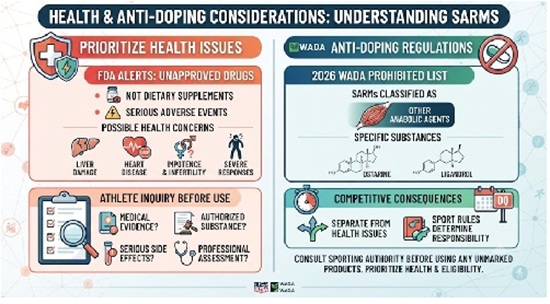
Including athletes have two areas to think about. One refers to health condition and the other to the eligibility to complete.
Prioritize Health Issues over Performance Assertions
FDA alerts warn that SARMs are unapproved drugs not approved dietary supplements. Also sounding an alarm on the serious adverse events associated with products having these substances.
The FDA has flagged possible concerns such as liver damage, heart disease, impotence, infertility, and other severe responses.
Athletes Should Inquire Before Making Any Related Claim:
- Is the claim backed by good medical evidence?
- Is that substance authorized for the human-use being proposed?
- Is there proof of serious side effects?
- Has a healthcare professional that is qualified assessed the issue?
These questions use evidence, not marketing promises, as a basis.
Competitive athletes have added responsibilities
Anti-doping regulations add an extra layer of risk. The 2026 WADA Prohibited List includes SARMs as other anabolic agents. Provided substances include estuarine, ligandrol and other examples.
SARM athlete education resources should clarify that competitive consequences may exist separately from health issues. The rules of the sport often determine the athlete’s responsibility.
Before using unmarked performance, bodybuilding or recovery products, anti-doping education is crucial. When in doubt, athletes should consult their relevant sporting authority.
Evidence-Based Education Vs Promotional Claims Comparison
Picture a pair of competitive athletes encountering discourse online around a SARM-containing performance product.
The first athlete relies primarily on influencer video and customer reviews. Claims about quick results get more attention than regulatory status or documented health issues.
The second athlete looks at official health guidance and anti-doping information. The athlete takes professional medical advice into account before deciding.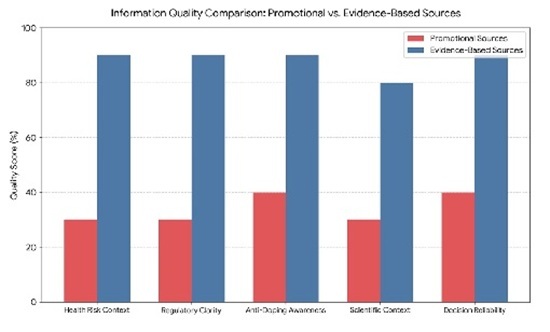
- Health risk context gets 90 percent for evidence-based sources and 30 percent for promotional sources.
- Regulatory clarity rises to 90% with evidence-based sources and only 30% with promotional sources.
- The score for anti-doping awareness was found to be 90% for evidence-based sources and 40% for promotional sources.
An athlete’s guide to assessing SARMs info
Who created the information? That’s the Starting Point A doctor, seller, influencer, an anonymous forum contributor; a regulator or a sports authority may have very different incentives.
Check out whether the material identifies risks and claimed benefits. Offering only desirable outcomes could be misleading, and should thus be viewed as suspicious.
An accountable research process can include:
- Verify authoritative regulatory details first.
- Go through the current rules of the relevant sporting authority
- Consult qualified professionals for health queries.
- View commercial testimonials as promotional proof.
The date it is published also matters. Drugs and regulations change over time. Therefore, it is better for the athlete to check what is current than rely on what was discussed at an earlier time.
Product names alone may not reveal exactly what a supplement contains. For muscle-building products, reviewing labels, ingredients, and marketing claims carefully can help reduce uncertainty.
Supplement education becomes part of career management for competitive athletes. The goals of training must never be considered regardless of health and eligibility.
Education Determines Stronger Performance Outcome
The consistent effect of training, nutrition, recovery & informed decisions on athletic development. Doesn’t let quick-fix promise blind you from the facts.
The most valuable SARM athlete education resources are those that include health evidence, regulatory status and anti-doping information.
The FDA warns that SARMs are not approved for consumer bodybuilding and may pose serious health risks. People focused on reducing fat or improving physique should understand these safety concerns.
Also, the 2026 WADA Prohibited List includes SARMs (selective androgen receptor modulators) in the list of prohibited anabolic agents.
In the end, it is education that provides what marketing cannot supply – context. Athletes who perceive uncertainty, health risks and sporting rules select actions with a much clearer view of consequences.
Strong performance planning should protect both health and future opportunities. Hardcore SARMs USA emphasizes reliable information as an important part of responsible athletic preparation.
